
Burst pipes and leaks, repaired by local plumbers
Water is spreading and you need someone now. We connect Greer homeowners with local pipe repair professionals for burst pipes, hidden leaks, slab leaks, sewer line damage, and whole-house repiping.
- Local service area
- Burst pipe and leak focus
- Licensed plumbers only
We are a referral service. We connect you with independent local plumbers and do not perform the work ourselves. Pricing and availability are set by each provider.
What does pipe repair involve?
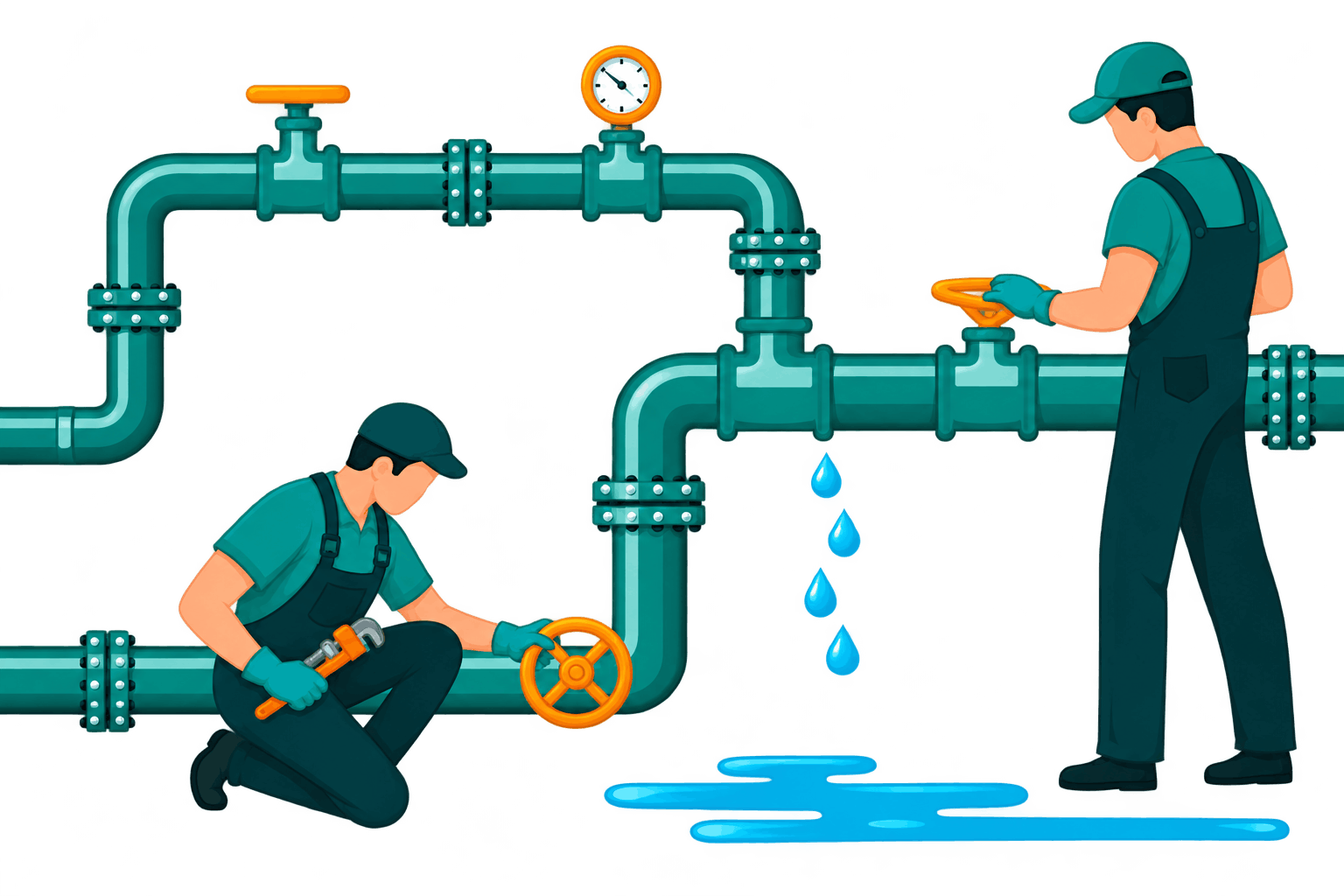
Pipe repair means finding where water or waste is escaping, stopping the damage, and restoring normal flow. The right fix depends on the pipe material, its location, and how much of it is damaged.
The short answer
Most pipe problems follow the same pattern. Water or waste leaves the pipe through a crack, a failed joint, a corroded section, or a blockage that builds pressure behind it.
The repair starts by locating the exact point of failure. From there, the plumber chooses a spot repair, a section replacement, a trenchless lining, or a full repipe.
Early signs homeowners miss
- A stain on a ceiling or wall
- A water bill that rises with no change in use
- A drain that gurgles or drains slowly
- A cold tap that suddenly runs weak
Acting early usually costs less than waiting for the damage to reach flooring, drywall, or the foundation.
Understand your options, learn the warning signs for each repair type, and connect with a local plumber who handles that work. Every service page explains how the repair works, what to expect, and what to have ready before the plumber arrives. Start with the service that matches your symptom, and call if you are unsure which one applies.
Pipe repair services we connect you with
Each service below is a specific type of pipe work. Choose the problem you are dealing with to read how it is handled.
Emergency Burst Pipe Repair
Active flooding, ruptured pipes, and sudden leaks need fast shutoff and a rapid repair. Learn the first steps to take while you wait for a plumber to arrive, and what the repair usually involves.
Read the burst pipe guideHidden Water Leak Detection
Locating leaks behind walls, under floors, and in ceilings without tearing out more than necessary.
Explore leak detectionSlab Leak Repair
Water or sewer lines under a concrete foundation, found and repaired with minimal slab disruption.
See slab leak optionsMain Sewer Line Repair
Collapsed, cracked, or root-blocked main sewer lines that connect your home to the city system.
Read about sewer repairTrenchless Pipe Lining
Repairing damaged underground pipes from the inside, without digging up yards or driveways.
Learn about pipe liningDrain Cleaning and Hydro-Jetting
Stubborn clogs, grease buildup, and tree roots cleared with high-pressure water.
See drain optionsWhole-House Repiping
Replacing old galvanized or polybutylene plumbing with modern PEX or copper.
Read the repiping guideMain Water Line Repair
Fixing or replacing the primary underground line that brings water from the street meter into your home.
See main line repairFind the repair you need
Which problem matches what you are seeing?
Match what you notice to the most likely cause. If more than one applies, start with the most urgent one.
Water is spraying or pooling now
Shut the main valve first, then call for emergency repair.
Water bill is up with no change in use
Often a hidden leak. Check the meter with all taps off.
Hot spots or cracking floors
A warm patch on a concrete floor can signal a slab leak.
Several drains back up together
When multiple fixtures slow down at once, the main line is often the cause.
One sink or tub drains slowly
Usually a local clog that responds well to cleaning.
Leaks keep appearing in different places
Repeated leaks in an older home can point to whole-system wear.
Causes, detection, and what happens after a repair
Understanding why pipes fail makes it easier to choose the right repair and avoid repeat problems.
What causes pipes to fail?
Most failures come from four sources. Each one leaves a different pattern you can recognize.
Water pressure
Pressure above the normal range strains joints and fittings. Sudden spikes can split a pipe that was already weak.
Corrosion
Galvanized steel rusts from the inside out. The channel narrows, then the wall thins until it cracks.
Ground movement
Shifting soil, freeze and thaw cycles, and tree roots push on buried lines and pull joints apart.
Pipe material
Polybutylene is known for brittleness. Cast iron and clay drain lines crack or separate at joints over time.
Modern PEX and copper last longer, but installation errors and freezing can still cause failures.
How are hidden leaks found?
Hidden leaks rarely show themselves early. A plumber narrows the search in steps, so the smallest possible area is opened.
Meter reading
With every fixture off, a moving meter dial means water is escaping somewhere.
Pressure testing
Sections of the system are isolated and tested to find which one loses pressure.
Acoustic listening
Sensitive devices pick up the sound of water moving through a break.
Thermal imaging
Warm spots on floors or walls can reveal hot water lines that are leaking.
What happens after a pipe is repaired?
A finished repair should be tested before the area is closed up. Ask the plumber to confirm each of these steps.
- The repaired section is pressure tested and holds.
- Water service is restored and every fixture drains properly.
- Opened walls or floors are patched or closed.
- The area is cleaned, and debris is removed.
- You are told what was found, what was replaced, and what to watch for.
Watch the area for the next two to three weeks. New staining, a change in water pressure, or a musty smell means the plumber should check again.
Why do some repairs fail again?
Repairs fail when only the visible symptom is treated. The rest of the system is often in the same condition.
- One leaking joint is fixed, but the rest of the same line is corroded.
- A clog is cleared, but the main line is partly blocked further down.
- A pipe is patched, but its material is the real problem.
A full assessment looks at pipe material, age, water pressure, and drainage pattern before a fix is recommended.
A repair that fixes the cause costs more on the day but usually saves money over several years. Patching the same line again and again adds up quickly, especially when each visit includes wall or floor restoration.
Do not use a chemical drain cleaner on a line you think is cracked. It can damage older pipes and splash hot, caustic liquid back at you when it cannot clear the blockage. Call a plumber instead.
Photograph your water meter with all fixtures off, then check it again two hours later. If the reading changed, share that with the plumber.
Before agreeing to work, ask the plumber to explain the cause, the proposed fix, and why it was chosen over the alternatives.
From first call to finished repair
A typical repair follows four steps. The exact timing depends on the problem and the provider's schedule.
- 01
Describe the problem
Tell us what you see, where it is, and whether water is active right now. This helps match you with the right provider.
- 02
Find the source
The plumber locates the leak or blockage using inspection, pressure testing, or detection tools.
- 03
Choose the fix
You receive an explanation of the repair options, including what each one involves and what to expect.
- 04
Test and restore
The line is tested before the work is closed up, and the plumber confirms it is holding and draining.
Why a small leak becomes a large repair
Water is one of the most damaging things in a home. Delays turn a contained problem into a wider one.
Damage spreads quietly
Water moves through wall cavities and under flooring. By the time staining shows, the wood, insulation, or subfloor may already be soaked. Drying and replacing these materials costs more than fixing the leak early.
Water loss adds up
A steady leak keeps charging you for water that never reaches a tap. Over weeks, that loss can exceed the cost of a repair, even before any structural damage is counted.
Mold grows fast
Mold can start within a day or two in damp, dark spaces. Once it spreads into drywall and insulation, removal becomes a larger job that affects air quality as well.
Foundations and floors suffer
Continuous water under a slab can soften the soil beneath it. Ignoring a slab leak risks uneven floors and cracks that are expensive to address.
Cost factors for pipe repair
Every repair is different. These factors explain why two similar-sounding jobs can cost very different amounts. We do not publish prices, because each provider sets their own.
| Factor | What it means | Why it matters |
|---|---|---|
| Pipe location | Exposed, inside walls, under a slab, or buried in the yard | Access determines how much labor and disruption is needed |
| Pipe material | Copper, PEX, galvanized steel, polybutylene, cast iron, or clay | Some materials need specialized fittings or full replacement |
| Length of damage | A single section or many feet of line | Longer runs take more time and materials |
| Damage to surrounding areas | Flooring, drywall, cabinets, or landscaping affected | Restoration can add more to the job than the pipe itself |
| Timing | Emergency after-hours call versus scheduled visit | Urgent calls may carry different scheduling terms |
| Permits and inspections | Some sewer and main line work requires local approval | Inspection steps add time and paperwork |
Pipe repair across Greer and nearby neighborhoods
We connect homeowners across Greer and the neighborhoods around it with local plumbers who know the area's housing and pipe materials. Each neighborhood page covers the pipe problems most common in that community, and telling us your street when you call helps the provider arrive ready.
Taylors
Older lots and newer subdivisions along US 29.
Pipe repair in TaylorsMauldin
A busy city with a broad mix of home ages.
Pipe repair in MauldinSimpsonville
Growing city with many established neighborhoods.
Pipe repair in SimpsonvilleWade Hampton
Residential community on the US 29 corridor.
Pipe repair in Wade HamptonFive Forks
Growing community between Greenville and Mauldin.
Pipe repair in Five ForksBerea
Residential community with long-standing neighborhoods.
Pipe repair in BereaGantt
Suburb next to Greenville with established homes.
Pipe repair in GanttHow it works
Pipe Repair Greer SC is a referral service. You call or send a request, we ask a few questions about the problem, and we connect you with an independent local plumber who handles that type of repair. You then agree on the work and price directly with that provider.
We do not perform plumbing work, and we do not set provider pricing. Each plumber is responsible for their own quotes, scheduling, workmanship, and any warranty they offer. Ask any provider to confirm their license and insurance before the work starts.
What to check before you hire
- Confirm the plumber is licensed for the work in South Carolina.
- Ask whether they carry liability insurance.
- Request a written explanation of the repair before work starts.
- Ask how the repair is tested before the area is closed up.
- Get any warranty terms in writing.
What to have ready when you call
A few details help the plumber arrive ready to work and give you a clearer answer on the phone.
- The address and access instructions
- Where the water shutoff valve is located
- A photo of the damage or the leak
- The age of the home, if you know it
- Any recent repairs or plumbing work
Shut the water off first
If a pipe has burst, turn off the main shutoff valve immediately. If there is any sign of electrical danger near the water, switch off power at the breaker only if it is safe to reach. Call a plumber or a licensed emergency service next.
Leave the building right away, do not use switches or flames, and call your gas utility or 911 from outside.
Common pipe repair questions
How fast can a burst pipe be repaired?
Shut off the water at the main valve right away. A local plumber can often be scheduled the same day. The repair time depends on how many sections are damaged and how hard they are to reach.
What are the signs of a hidden water leak?
Common signs include a water bill that rises without more use, a warm spot on a floor, damp drywall, a musty smell, and a water meter that keeps moving when all taps are off.
What is a slab leak?
A slab leak is a break in a water or drain line that runs under a concrete foundation. It often shows up as hot spots, cracked flooring, or water loss with no visible cause.
Is trenchless pipe lining better than digging?
Trenchless lining repairs a damaged pipe from the inside, which avoids digging up lawns and driveways. It works best when the pipe is still mostly intact and the damage is not severe.
When should I repipe a whole house?
Repiping is usually considered when a home has galvanized steel or polybutylene pipes, leaks in several areas, or low water pressure that a single repair cannot solve.
Why does my drain keep clogging?
A recurring clog often points to grease buildup, a partial blockage further down the line, or root intrusion in the main sewer. Clearing the surface blockage alone may not stop the problem.
Can frozen pipes be fixed without replacement?
Sometimes. A plumber can thaw a frozen section safely and check for cracks. If a pipe has split from ice expansion, that section needs to be replaced.
Does my homeowners insurance cover pipe repair?
Coverage varies by policy. Many policies cover sudden burst damage but not gradual leaks or the cost of the pipe itself. Check your policy or ask your insurer directly.
What should I do if water is coming through the ceiling?
Turn off the water at the main valve, place a container under the drip, and move valuables away. Call a plumber to locate the source above the ceiling.
Do I need a permit for sewer line work?
Many main sewer and water line repairs require permits or inspections. Your plumber should confirm what applies before the work begins.
Call for pipe repair in Greer
Tell us what is happening and we will connect you with a local plumber for your repair.
555-555-5555Call now